The Method
A Broader View of Digestive Health
Digestive symptoms affect a significant number of people.
- Research suggests that around 10–15% of the global population is affected by irritable bowel syndrome (IBS)
- In Western populations, around 10–20% of people report symptoms consistent with IBS
- More broadly, disorders of gut–brain interaction may affect over 40% of people worldwide
There is also growing evidence that these conditions are becoming more visible and more frequently reported—shaped by modern lifestyle factors, as well as improved recognition and diagnosis.
Despite this, most approaches to digestive health still focus narrowly on food or symptom management.
What is often missing is an understanding of how the body itself—through movement, posture, breath, and internal organisation—can support or restrict digestive function.
Sources
- Frontiers in Medicine — Global IBS prevalence study
- Global prevalence meta-analysis of IBS
- Epidemiology of IBS review
- Rome Foundation Global Study on disorders of gut–brain interaction

Moving With Guts - A Whole System Perspective
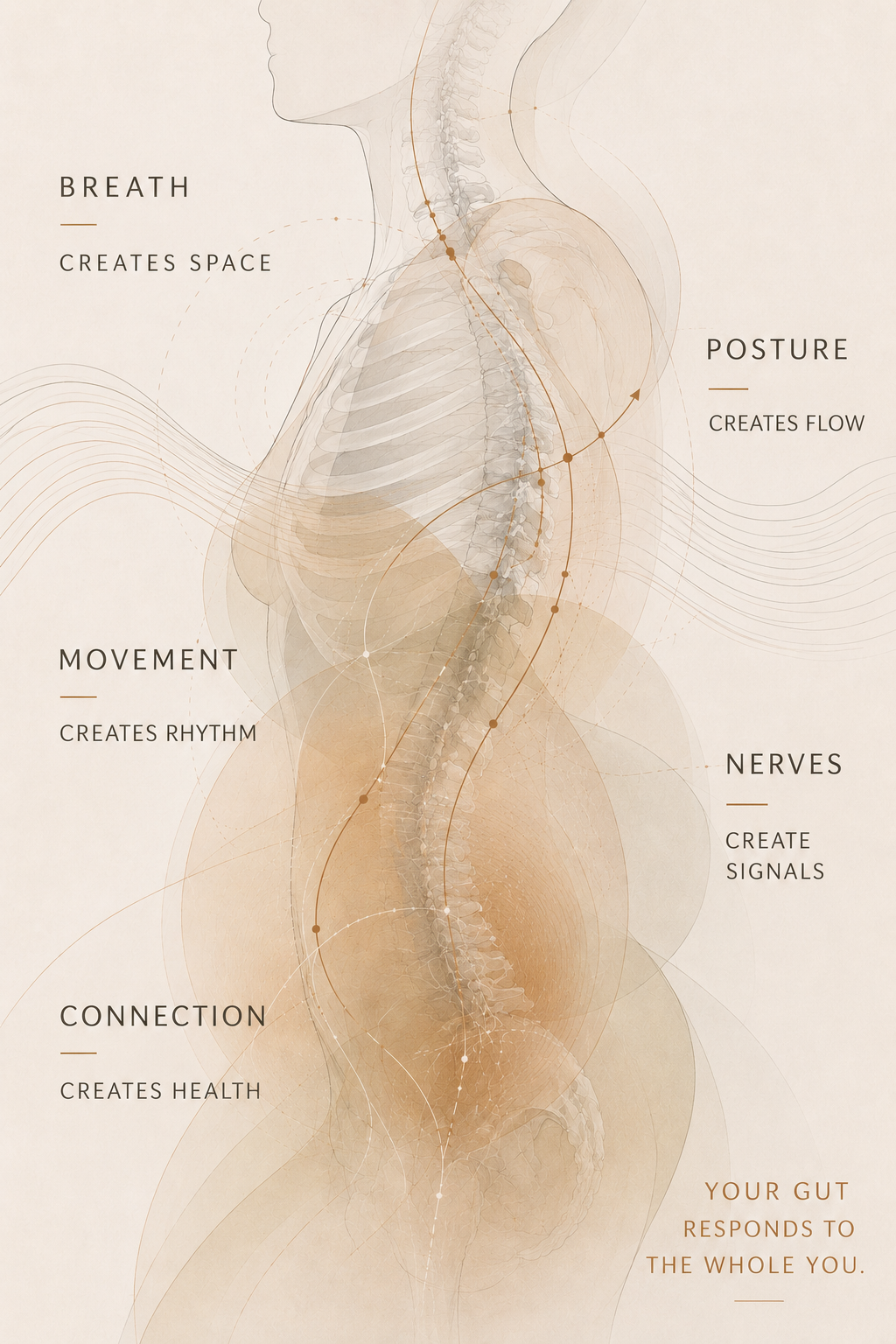
Moving With Guts is not a set of exercises.
It is a way of understanding the relationship between the body and the gut.
The central principle is simple:
The gut reflects the state of the system it sits within.
Digestion is influenced by:
- how the body is organised
- how pressure is managed internally
- how freely the breath moves
- how the nervous system responds to stress
This means that digestive function is not only biochemical—it is also mechanical, neurological, and behavioural.
THE BODY AS AN INTERNAL ENVIRONMENT
Space, Pressure, and Support
Inside the body, the abdominal cavity is not fixed—it is dynamic. It relies on a coordinated system involving:
- the diaphragm
- the abdominal wall
- the pelvic floor
- the spine
Together, these structures regulate:
- internal pressure
- movement within the organs
- support without compression
When this system is balanced:
- the abdomen can expand and recoil naturally
- breath moves more freely through the body
- organs are supported without restriction
When it is not:
- pressure becomes uneven
- movement becomes limited
- the system may feel tight, heavy, or stagnant
This is not about strength alone—it is about how the body distributes effort and space.
How Modern Habits Shape The Body
Over time, everyday patterns influence how the body organises itself.
Common patterns include:
- sustained sitting and forward posture
- habitual abdominal holding
- shallow or upper chest breathing
- over-reliance on isolated “core” effort
These patterns can subtly change:
- how pressure is managed
- how breath moves
- how space is maintained in the abdomen
The result is often not a single issue, but a pattern of restriction.
This is why many people experience ongoing discomfort without a clear structural cause.
Why Movement Matters
The digestive system relies on rhythm and motion. Not just internally—but through the body as a whole.
Movement helps to:
- vary pressure through the abdomen
- support circulation
- reduce unnecessary tension
- maintain adaptability in the system
Without this variation:
- the body becomes more fixed
- the system becomes less responsive
- function may feel less efficient
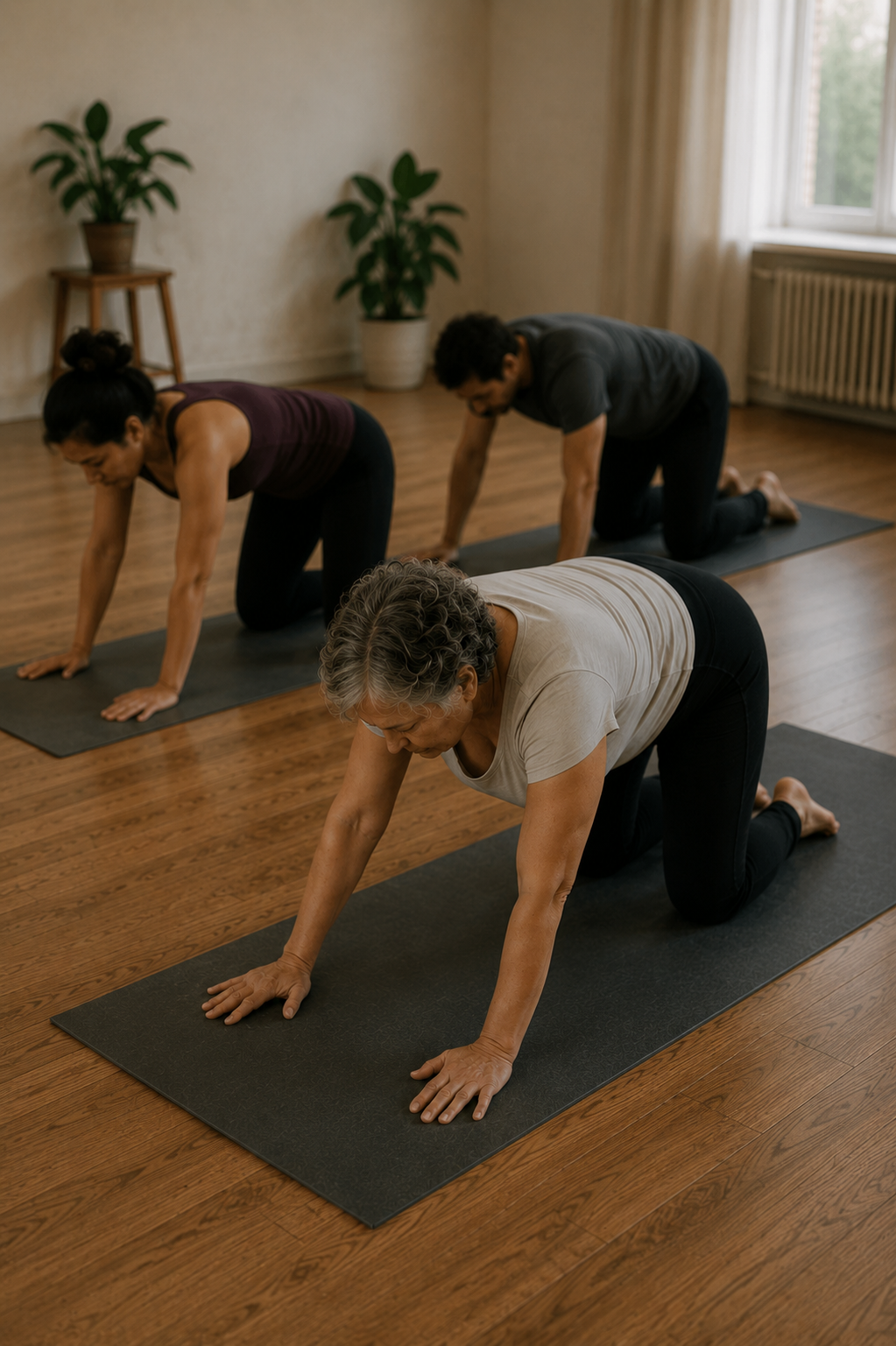
This is where a movement-based approach becomes relevant—not as exercise, but as organisation of the whole body.
Adapting To Natural Rhythms
The body does not operate the same way all year round. It responds to:
- light exposure
- activity levels
- environmental conditions
- shifts in routine and energy
Rather than applying the same input all year, this approach recognises changing needs. Different periods call for different qualities:
- expansion
- activity and flow
- recalibration
- grounding and support
This allows the body to:
- adapt without overload
- maintain balance over time
- avoid cycles of overcorrection
The SASSY Method - A Practical Framework
Understanding patterns is one step. Responding to them is another.
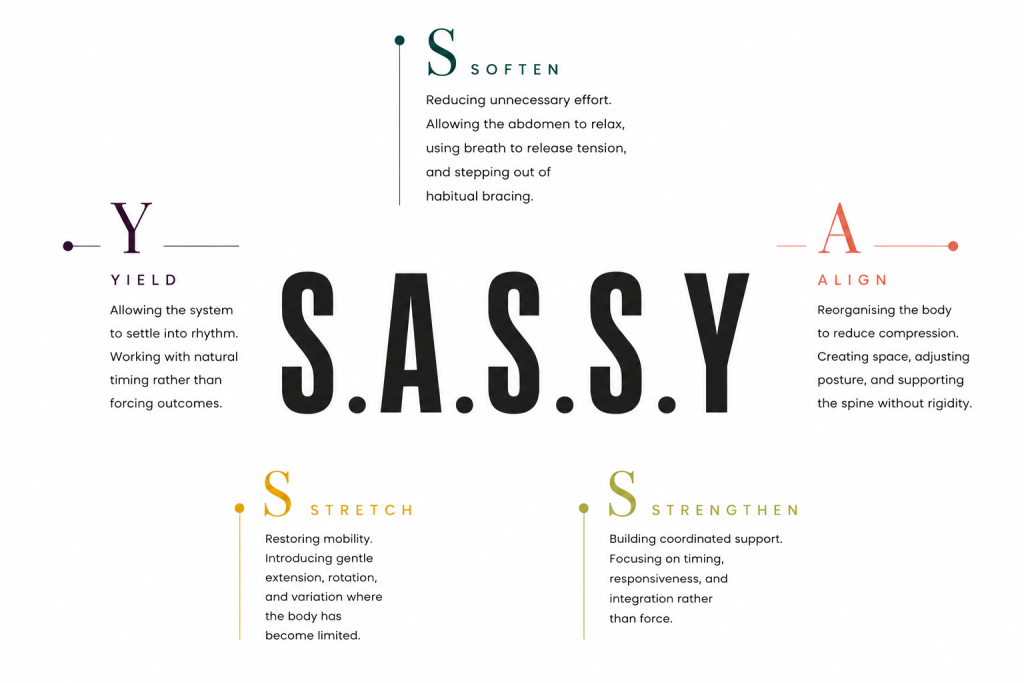
The SASSY Method, developed by Elena Voyce, provides a structured way to work with the body.
It is not prescriptive—it is responsive. It allows you to move between:
- tension and release
- support and ease
- activation and rest
From Concept to Practice
The value of this approach lies in its flexibility.
It can be applied:
- in short daily practices
- in response to specific patterns
- within changing environments (travel, stress, routine shifts)
Rather than relying on fixed routines, it develops the ability to:
- notice patterns
- adjust accordingly
- maintain balance over time
It offers a way to respond—not by forcing change, but by working with the body more intelligently.